skip to main | skip to sidebar

Wordsmith Wars

A Georgetown Professor and international government advisor, both syndicated journalists, bring a fresh perspective to current issues, literature and life.

Sunday, March 13, 2011

Nuclear Power: Hysteria on Steroids

By Sandy Prisant

(Editor's Note: the Author is a former manager at American Electric Power Co. and has helped build a safe Nuclear Power Plant)
How long must this irrational hysteria about everything nuclear paralyze us and our societies?  Whom would have heeded Peter and the Wolf for 65 years, when virtually no threats materialize?
 
But that doesn't stop perfectly experienced reporters from knee-jerk movement of any discussion about Japan now to to the most extreme, unlikely outcomes--making that the centerpiece of their alleged "news analysis".
 
Do you or those reporters know the first thing about building nuclear plants to exacting specifications?  Do you know that for all the hysteria about Three Mile Island, no one there even broke an ankle?  Do you know that almost every flood, tornado or major car pile up kills more than virtually all nuclear plants, ever?

Do you know that Times' articles claiming Japan paid too little attention to future earthquakes before nuclear plant construction are flat out wrong?  Do you know that the very first bar for any plant in a developed nation is a reactor design that can withstand an earthquake epicenter smack underneath while a 747 is crashing into the containment structure above?

Do you know that for 40 Years, the Nuclear Regulatory Commission has required this as the minimum safety thresh hold they call MCD--Maximum Credible Disaster?

Do you think Chernobyl in a collapsing nation is any more representative of nuclear safety than the victory of Adolph Hitler in 1933 was of free and fair elections?

Finally, if these plants were unsafe, have you wondered why terrorists haven't crashed a plane into one of them--anywhere in the world?  Wouldn't it be much worse than hitting a building, you say?

No it wouldn't, because Al Qaeda knows more than you do about the strength of these vessels and why they're pretty much impregnable.

Do you appreciate that nations like France and Japan have been getting the majority of their
energy from nuclear power with NO accidents for decades, but you never hear about it?

Finally, do you realize that we could have had safe nuclear power with far less foreign oil for the past 40 years, avoiding the War in Iraq; instead we've stuck with coal, directly giving our grandchildren the highest rates of asthma mankind has ever seen?

That is the real effect of the freedom you've been given to be hysterical for two generations.
Posted by Sandy Prisant at 5:03 PM 0 comments

Saturday, February 19, 2011

And You Thought Our Big Problem Is Debt??

By Sandy Prisant


Here's a look at how the United States compares with other advanced economies.

Posted by Sandy Prisant at 6:35 PM 0 comments
Labels: Debt, Democracy, Income, Unemployment

Monday, January 24, 2011

The Banks: Capitalism's Own Worst Enemy

By Sandy Prisant

This morning I closed all my bank accounts at  J P Morgan Chase. It was where my father opened my very first account when I was 16. I remember Mr. Marty, the branch manager in Great Neck, NY. Nice smile. Nice man. 

How things have changed.  I had opened additional accounts with the guarantee of no-fee checking for life a few years ago, but this month Chase has swooped in and arrogantly broken that guarantee for all customers. No apologies. No explanations. This hardly caused a ripple, because we all now expect banks to abuse us to an extraordinary degree.

In recent days, Goldman Sachs has announced bonuses of SIXTEEN BILLION TWO HUNDRED MILLION DOLLARS for results in the same year that 1.2 million American families lost their homes .  And now we learn that US taxpayers will be picking up tens of millions in legal fees for some of our public bankers at Fannie and Freddie Mae, whom are millionaires in their own right, but with the ethics of bag ladies (New York Times/Jan 24).  In the same  week, two other financial institutions are petitioning the courts to burn their sub prime loan records.

The questions abound:
  • What has happened to the re-establishment of banking regulation that was so vital in ending the last Depression? The stripping of Glass-Steiglitz regulation is a primary cause of this Depression. What is Washington waiting for?
  • We created TARP to keep the banks and the economy liquid. The banks, on their own, decided to take the money, but not pass it on.Single-handedly they have made America illiquid. Can neither the Fed nor the Comptroller of the Currency oblige banks to make sound loans--as has been required in the United Kingdom?
  • In short, if the Banks were a foreign enemy or terrorist organization, could they do any greater harm, more effectively, to the United States?
  • And could they do it with greater disdain? 
The root of the word "capitalism" is "capital".  It is our understanding that in a free enterprise system, capital is the core element in economic development and that it comes through institutions called banks.  In this  Post-Prosperity Era, banks have decided they are not here to provide capital, but to charge fees for everything imaginable, pay out little or no interest but demand huge credit card fees and interest, while simultaneously repossess our homes. That's their entire business model.

Except for those bank shareholders who receive dividends, there is in fact no "Capitalism" being conducted by these institutions. 

Recently people were fascinated to see Goldman "invest" a large sum in Facebook, suggesting that website was worth billions, but Goldman was proving nothing of the sort. In fact the investment bank was simply doing what it does best:  (1)Acquiring equity that could be re-sold to existing or new clients at a profit and with commissions and (2) Putting itself in an almost unassailable position to earn hundreds of millions more for handling Facebook's IPO in the next five years.

Any corporation has the right to make a profit. But only banks have as their raison d'etre facilitating not just a nation's profits, but its economic survival through Main Street liquidity.

The banks are quite clearly telling us that is not their role and they want nothing to do with it.  In the words of  Nobel Laureate in Economics, Joseph Stieglitz: "If bankers win, they walk off with the proceeds, and if they lose, taxpayers pick up the tab."

Which leaves us with the greatest question of all:  If banks no longer will provide capital, what is the future of Capitalism? A recent study shows almost half of all Americans believe our nation's best days are behind us. With banks like ours, we can't blame this one on China.
Posted by Sandy Prisant at 6:29 PM 0 comments
Labels: Banks, Chase, Depression, Fannie Mae, Freddie Mae, Goldman Sachs, Stieglitz, sub prime, TARP

Friday, January 7, 2011

The Future Doesn't Work

Editor's Note:  As we enter Year 4 of this Depression, history reminds us that we are at the nadir of the economic cycle. The budget cutting, the downsizing, the firings--it's all been done.  The savings for "a rainy day" will now begin running out for most Americans and small business at an accelerated pace, this year and next--which brings us to ideas for solutions.  According to the American voter, we should now try a solution that has already proven it will not work:

The Texas Omen

By PAUL KRUGMAN 
January 6, 2011
Wait — Texas? Wasn’t Texas supposed to be thriving even as the rest of America suffered? Didn’t its governor declare, during his re-election campaign, that “we have billions in surplus”? Yes, it was, and yes, he did. But reality has now intruded, in the form of a deficit expected to run as high as $25 billion over the next two years.


And that reality has implications for the nation as a whole. For Texas is where the modern conservative theory of budgeting — the belief that you should never raise taxes under any circumstances, that you can always balance the budget by cutting wasteful spending — has been implemented most completely. If the theory can’t make it there, it can’t make it anywhere.

These are tough times for state governments. Huge deficits loom almost everywhere, from California to New York, from New Jersey to Texas.
How bad is the Texas deficit? Comparing budget crises among states is tricky, for technical reasons. Still, data from the Center on Budget and Policy Priorities suggest that the Texas budget gap is worse than New York’s, about as bad as California’s, but not quite up to New Jersey levels.

The point, however, is that just the other day Texas was being touted as a role model (and still is by commentators who haven’t been keeping up with the news). It was the state the recession supposedly passed by, thanks to its low taxes and business-friendly policies. Its governor boasted that its budget was in good shape thanks to his “tough conservative decisions.”

Oh, and at a time when there’s a full-court press on to demonize public-sector unions as the source of all our woes, Texas is nearly demon-free: less than 20 percent of public-sector workers there are covered by union contracts, compared with almost 75 percent in New York.

So what happened to the “Texas miracle” many people were talking about even a few months ago?

Part of the answer is that reports of a recession-proof state were greatly exaggerated. It’s true that Texas job losses haven’t been as severe as those in the nation as a whole since the recession began in 2007. But Texas has a rapidly growing population — largely, suggests Harvard’s Edward Glaeser, because its liberal land-use and zoning policies have kept housing cheap. There’s nothing wrong with that; but given that rising population, Texas needs to create jobs more rapidly than the rest of the country just to keep up with a growing work force.

And when you look at unemployment, Texas doesn’t seem particularly special: its unemployment rate is below the national average, thanks in part to high oil prices, but it’s about the same as the unemployment rate in New York or Massachusetts.
What about the budget? The truth is that the Texas state government has relied for years on smoke and mirrors to create the illusion of sound finances in the face of a serious “structural” budget deficit — that is, a deficit that persists even when the economy is doing well. When the recession struck, hitting revenue in Texas just as it did everywhere else, that illusion was bound to collapse.

The only thing that let Gov. Rick Perry get away, temporarily, with claims of a surplus was the fact that Texas enacts budgets only once every two years, and the last budget was put in place before the depth of the economic downturn was clear. Now the next budget must be passed — and Texas may have a $25 billion hole to fill. Now what?
Given the complete dominance of conservative ideology in Texas politics, tax increases are out of the question. So it has to be spending cuts.

Yet Mr. Perry wasn’t lying about those “tough conservative decisions”: Texas has indeed taken a hard, you might say brutal, line toward its most vulnerable citizens. Among the states, Texas ranks near the bottom in education spending per pupil, while leading the nation in the percentage of residents without health insurance. It’s hard to imagine what will happen if the state tries to eliminate its huge deficit purely through further cuts.
I don’t know how the mess in Texas will end up being resolved. But the signs don’t look good, either for the state or for the nation.

Right now, triumphant conservatives in Washington are declaring that they can cut taxes and still balance the budget by slashing spending. Yet they haven’t been able to do that even in Texas, which is willing both to impose great pain (by its stinginess on health care) and to shortchange the future (by neglecting education). How are they supposed to pull it off nationally, especially when the incoming Republicans have declared Medicare, Social Security and defense off limits?


People used to say that the future happens first in California, but these days what happens in Texas is probably a better omen. And what we’re seeing right now is a future that doesn’t work.


Posted by Sandy Prisant at 5:39 PM 0 comments
Labels: Budget, California, Depression, Gov. Rick Perry, Texas

Sunday, December 26, 2010

Outlook 2011: Is the Smart Money Right About China?

 Editor's Note:   In multiple media, this editor has defended China's economy and its coming world impact against the sour grapes hurled at it by angry Americans since the current Depression began. The following however is a tour de force that Wordsmith Wars believes demands pause for thought.


Dian L. Chu
Dian L. Chu picture
M.B.A., C.P.M. and Chartered Economist with a syndicated financial blog frequently published and quoted by media outlets worldwide


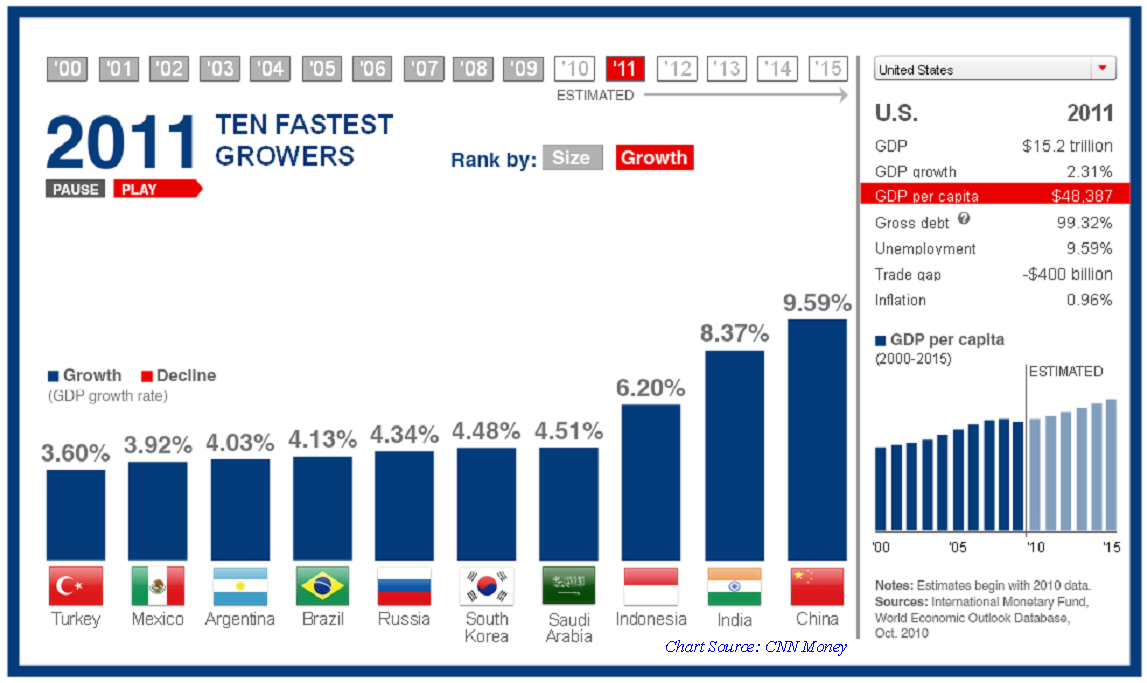
China has been ranked as the top growing country among the G20 since 2001, and is expected to retain that title for at least another five years (See Growth Chart). However, the news coming out of China for the past three months has not been good. It is looking more and more that it is not a question of if China is a bubble and going to burst, but when.
Click to enlarge images
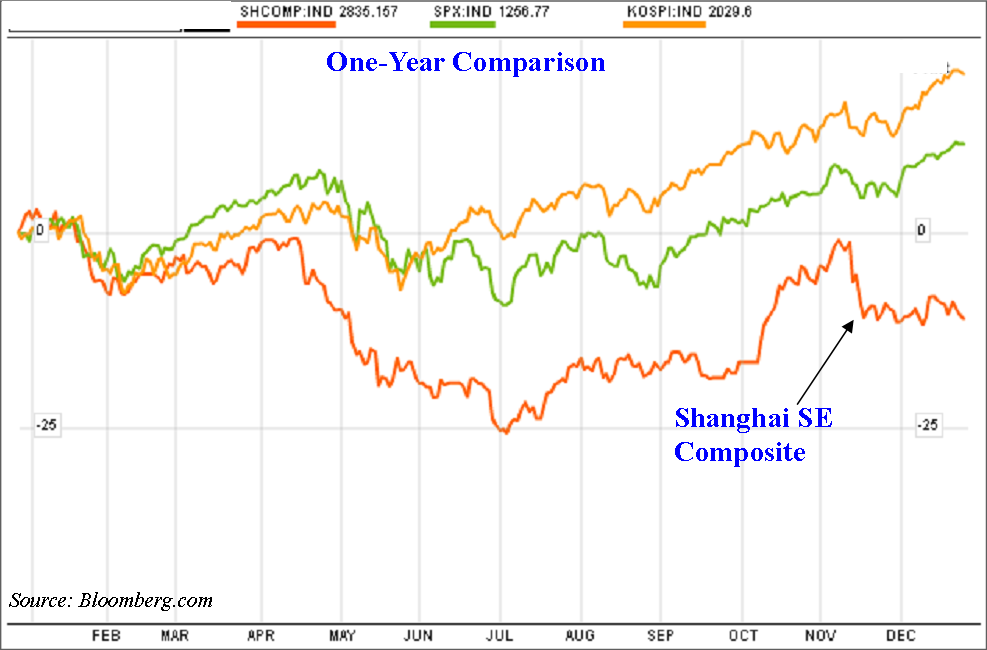
The country has major infrastructure issues, troubling population dynamics, poorly aligned employment outcomes, inflation problems, a real estate bubble, an opaque and potentially insolvent banking system (had mark-to-market accounting been applied), geo-political problems with North Korea and Taiwan, and an underperforming stock market in 2010 (see stock comparison chart).


Smart Money Rushing Out
While the hot money is flooding into China, the smart local money is doing everything they can to get their money outside of China, which partly explains why Shanghai SE Composite has underperformed other markets for the past year or so (see Comparison Chart).
The many issues of China could conspire to become the biggest train wreck waiting to happen, and potentially dwarf any little budget problems in Europe by a factor of ten.


Big Trouble In Big China
China has a population related societal structural problem. The nation has tried to utilize the vast manpower to its advantage over the last two decades building a powerhouse manufacturing economy through the availability of low cost workers, which supplied the world with lower cost goods.
Nevertheless, the harsh reality is that the nation's infrastructure, quality jobs, food, and overall resources are too scarce to support such mass population, while achieving the government's goal of a smooth transition to a developed middle class to sustain an internal demand model going forward.
If you think having riots in Greece over the pension retirement age being raised is bad, just wait till riots break out in Beijing and other cities over a 90 cent bowl of noodle soup now costing four dollars due to food shortages, and a runaway inflation problem.

Loose Lending = Non-performing Projects
This is only reinforced by some of the news events taking place over the last three months. Let's start with the raising of banks reserve requirements by the central bank, which is the sixth such increase in 2010.
These measures are meant to curb the excess lending which has fueled much of the overbuilding and real estate speculation occurred over the past two years as China`s central bank initially wanted to avert a recession by artificially creating demand for workers and construction projects to replace lagging demand from the developed economies.
The problem is that too much lending has occurred, and bad lending at that. Because of the cheap available credit, now you have cement companies and manufacturing firms getting bank loans to invest in endeavors such as real estate, which is outside of their core expertise and competency.

Real Estate Misery Loves Company – China & Spain
The result is a bunch of excess inventory and poorly thought-out construction projects which have no means of recouping the initial investment needed to repay the bank loans.
This practice is similar to Spain`s situation now, where they have entire uninhabited building complexes that have yet to be marked to market, and will probably ultimately be demolished. But at least in Spain, even though it was a construction boom, it was engineered by developers in Spain, and not by some manufacturing outfits like those in China.
So, multiply the bad business project factor by ten and you get an understanding of the magnitude of bad loans on the books of Chinese banks. The problem is being further exacerbated by the practice similar to Spain's-- of banks making additional loans to the businesses just so that they can then turnaround and pay back the interest owed on the original loans.
The only way this would work out is if these projects magically develop revenue streams. Unfortunately, in the case of Spain, a 20% unemployment rate, coupled with a still overvalued housing market in which prices still need to come down significantly, would suggest that by the time the Spanish economy recovers enough to support the excess inventory, the abandoned projects are run down and uninhabitable.
A similar scenario could play out in China as well.

True Smart Money Wary of the Write-off Domino
Furthermore, China's practice of overbuilding at the height of real estate valuations makes even haircuts on loan write-offs an untenable practice for banks, and by further throwing good money after bad, the ultimate mark- to-market effect could be catastrophic for Chinese Banks.
This is the main reason all the major Chinese banks have gone to the market in 2010 to raise more capital before investors wise up to the underlying deficits these banks face, as these bad loans eventually would need to be written off the books.
Victor Shih, a Northwestern University professor estimates that Chinese local governments borrowed some 11.4 trillion renminbi at the end of 2009, and that local government financing loans to be roughly one-third of China's 2009 GDP.
Shih reckons the most likely scenario over the next few years is that there would be increases of non-performing loans ratio from local governments. This would require a large scale of recapitalization of the Chinese banking system, which would eat up a large share of China's foreign exchange reserves and possibly slow down growth.
I do believe Beijing is quite capable of a few bailouts and surviving a widespread banking crisis, but this most definitely will not bode well for the financial markets. That's most likely why you see insiders removing capital from direct exposure to the inevitable re-pricing that will happen throughout Chinese markets from real estate to the stock market.
This can be seen at this early stage by the underperformance of the Chinese stock market compared to other global markets. Remember, foreigners cannot invest directly in these markets, so these capital outflows are truly the smart money.

Logistic Gridlock Crimping the Middle Class
Next let's look at the recent news regarding a severe cutback in automobile registrations in Beijing to 240,000 in 2011 from 700,000 registered in 2010 by the municipal government. Other large cities in China are bound to follow. This is most likely related to the reported 9-day traffic jam on the Beijing-Tibet expressway in August, and other extended traffic jams throughout China in 2010.
China is trying to build infrastructure projects after the fact; whereas with proper central planning these should have been established far ahead of the massive transition from a rural, agricultural based populous to that of a modern, large city based business and manufacturing concentration.
Simply put, it is impossible for all the Chinese citizens who want and can afford automobiles to be able to own and utilize this form of transport without a total breakdown in the transportation system. We are seeing the early stages of complete and counterproductive gridlock in the transportation system of China, and it is only going to get worse over the next decade.

No Jobs for College Grads
For all the talk about how China graduates more engineers each year, and other college educated young people who have strong backgrounds in the hard sciences than most developed nations combined, this is actually another sign of problems to come over the next decade in China.
China's wealth and emergence into the second largest business economy hasn't been built around the need for these types of mind and skill set. So literally, you have a large mismatch between the types of available jobs in China, that are supported by the heavy manufacturing and construction intensive focus of the past twenty years, to that of the recently educated pool of graduates who have grown in sizable numbers over the past five years.

The Mind Is A Terrible Thing To Waste
This results in a large human asset class that China is currently wasting, as most of the newly educated workforce is working in jobs which require little or no advanced education at the university level. So you have highly educated university graduates in areas like engineering and accounting working low level service and sales jobs that pay less than many manufacturing jobs.
In short, there are too many highly educated Chinese citizens graduating each year for the number of jobs available needing their skill set because China`s economic model isn`t built around these type of jobs. This type of misaligned employment outcome never ends well; it usually manifests itself in increased civil and social unrest.

8% Inflation in 2011
The next major challenge for China is skyrocketing inflation, which at its root is the fact that there are too many people chasing too few resources. This fundamental flaw in population dynamics underpins many of the problems that China faces going forward.
Recent CPI data for November illustrates the inflation problem in China with a reading of 5.1% from a year ago comparison, this is up from a 4.4% reading for the previous month. Couple this with the latest 4% hike in fuel prices in China because of rising oil prices, you could expect future CPI and PPI reports to reflect even higher rates of inflation.
For now, most of the year over year spike has revolved around higher food prices as energy has mainly been flat for 2010 thanks mostly to government subsidies. Now that energy prices have entered the picture, China will start to experience even more inflation pressures in 2011.
Furthermore, with the undervalued yuan pegged to the dollar, it is only getting worse for China in 2011 due to Fed's QE2 pressures on the dollar. The real inflation rate for Chinese citizens for 2011 will probably approach 8% next year.

An Asian Contagion by China?
This escalating inflation concern is further compounded by Beijing's lack of decisive action to combat the problem by delaying a much needed currency appreciation, and hiking interest rates in a timely fashion. There is no getting around the fact that these two things need to occur as soon as possible.
By the time the Chinese government is forced to implement these tightening tools, the damage to the economy is most likely already done. The longer China delays the inevitable serious tightening measures, the harder the economic crash that will occur in the aftermath of these policy changes. And it is unlikely to end well. The resultant impact will probably take the rest of the Asian economies down with it – an Asian Contagion scenario.

History Repeats Itself
Eventually central planners and finance ministers around the world might start to understand that policies which lead to bubbles being formed in the first place are counterproductive in the long run. But until that lesson is learned, it seems like we are doomed to repeat the same mistakes over and over again.
Right now, there are more and more signs coming out of China that all is not well with its economy, and the likelihood of a more severe downturn in the future is a distinct possibility, unless its policy makers take decisive and prudent actions to minimize the damage of a hard landing
Posted by Sandy Prisant at 5:42 PM 0 comments
Labels: China, dollar, inflation, yuan

Tuesday, November 23, 2010

The American Way?

Ed- American capitalism is working more efficiently than ever. What does that mean for the future of our country?


Corporate Profits Were the Highest on Record Last Quarter
By CATHERINE RAMPELL


Published: November 23, 2010


The nation’s workers may be struggling, but American companies just had their best quarter ever.

American businesses earned profits at an annual rate of $1.66 trillion in the third quarter, according to a Commerce Department report released Tuesday. That is the highest figure recorded since the government began keeping track over 60 years ago, at least in nominal or non-inflation-adjusted terms.

Corporate profits have been going gangbusters for a while. Since their cyclical low in the fourth quarter of 2008, profits have grown for seven consecutive quarters, at some of the fastest rates in history.

This breakneck pace can be partly attributed to strong productivity growth — which means companies have been able to make more with less — as well as the fact that some of the profits of American companies come from abroad. Economic conditions in the United States may still be sluggish, but many emerging markets like India and China are expanding rapidly.

Tuesday’s Commerce Department report also showed that the nation’s output grew at a slightly faster pace than originally estimated last quarter. Its growth rate, of 2.5 percent a year in inflation-adjusted terms, is higher than the initial estimate of 2 percent. The economy grew at 1.7 percent annual rate in the second quarter.

Still, most economists say the current growth rate is far too slow to recover the considerable ground lost during the recession.

“The economy is not growing fast enough to reduce significantly the unemployment rate or to prevent a slide into deflation,” Paul Dales, a United States economist for Capital Economics, wrote in a note to clients. “This is unlikely to change in 2011 or 2012.”

The increase in output in the third quarter was driven primarily by stronger consumer spending. Wages and salaries also rose in the third quarter, which might help bolster holiday spending in the final months of 2010.

Private inventory investment, nonresidential fixed investment, exports and federal government also contributed to higher output. These sources of growth were partially offset by a rise in imports, which are subtracted from the total output numbers the government calculates, and a decline in housing and other residential fixed investments.
Posted by Sandy Prisant at 6:19 PM 0 comments
Labels: Economy, Jobs, Profit, Recession

Friday, November 5, 2010

Want Sane Politics? Start Here:

  Editors note:   This is how the Mother of Parliaments deals with candidates or campaigns run on lies and half-truths. At a stroke. Can we learn? (reprinted from The Telegraph of London  (11/5).

 Labour minister barred from Commons for three years

Phil Woolas: Re-run ordered of Labour minister election win  
Phil Woolas loses seat after knowingly making false statements about opponent in May's general election.

The Labour MP could be barred from the Commons for three years, with the election contest for his Oldham East and Saddleworth seat set to be re-run. 

But Mr Woolas said he would fight the ruling - the first of its kind in 99 years - and was seeking a judicial review.

"The court has decided that an election should be overturned and an MP should lose his seat and be incapable of being elected to the House of Commons for three years because statements which attacked a candidate's 'political conduct' were also attacks on his 'honour' and 'purity'."

The court decided that the Oldham election should be be re-run, and that Mr Woolas should lose his seat and be barred from being elected to the House of Commons for three years.
It is now up to Commons Speaker John Bercow to decide whether to impose the three year ban, initiate a by-election for Oldham East and Saddleworth immediately or wait for further legal proceedings.

The Speaker's office said Mr Bercow would make a statement to the Commons on Monday.
Lord Falconer, the former Lord Chancellor, had earlier conceded that Mr Woolas would be forced out, saying he will not be Labour's candidate in the by-election that must now be held.

He said: "If there is to be a by-election, which it sounds like there is going to be, then Labour will have a new candidate."

Mr Woolas, who won May's general election with a majority of just 103 votes, is the first MP for 99 years to face a successful challenge to his election victory on the basis of publishing false statements about an opponent.

The specially convened election court had heard that the Labour MP stirred up racial tensions in a desperate bid to retain his seat in Oldham East and Saddleworth.


Giving their judgment, Mr Justice Nigel Teare and Mr Justice Griffith Williams said Mr Woolas was guilty of illegal practices under election law.

Mr Woolas was also found to have knowingly made a false statement that Mr Watkins had reneged on a promise to live within the constituency prior to the election.

That suggested Mr Watkins was "untrustworthy".
Posted by Sandy Prisant at 1:42 PM 0 comments
Labels: Election, political attacks
Newer Posts Older Posts Home
Subscribe to: Posts (Atom)

My Blog List

  • David Brooks - The New York Times
    How to Repair the National Marriage
    8 years ago
  • My Story Lives
    Well Oh Well, Here I am Going Phishing Again
    2 weeks ago
  • Paul Krugman
    The Blog Moves On
    8 years ago
  • Wordsmith Wars - My Telegraph
    The ObamaTest: Is It Too Soon To Grade Him?
    12 years ago

From America's youngest syndicated by-line journalist to roles as a strategic advisor to British and other governments, Alexander (Sandy) Prisant has fostered change in business and social/charitable movements on 4 continents. He branded a division of the International Red Cross for the US, launched the Walkman internationally for Sony, brought Hi Tech to Nelson Mandela's South Africa and new ideas in public health care policy to the Middle East.

Contributors

  • Claudia R
  • Sandy Prisant

Blog Archive

  • ▼  2013 (3)
    • ▼  September (1)
      • The Sunshine State
    • ►  August (1)
    • ►  July (1)
  • ►  2011 (14)
    • ►  July (1)
    • ►  June (3)
    • ►  May (5)
    • ►  March (2)
    • ►  February (1)
    • ►  January (2)
  • ►  2010 (14)
    • ►  December (1)
    • ►  November (2)
    • ►  October (1)
    • ►  September (1)
    • ►  July (2)
    • ►  June (1)
    • ►  May (2)
    • ►  March (1)
    • ►  January (3)
  • ►  2009 (8)
    • ►  December (3)
    • ►  November (1)
    • ►  October (4)

ShareThis

Powered By Blogger

Followers